Jan 21, 2026 at 17:17
Aug 31, 2025 at 15:03
Big News for the Blog
Wanted to let you all know that I have released the first major update to this blog since I launched it in 2022:
It’s now powered 100% by my own static site generator named Marginalia. �
Moving From Wordpres
Wordpress has always been a great blogging platform but it has some deficiencies. For one thing, I’ve been paying $10/mo for a VM all this time to run it. And a VM means I need to regularly patch it, and patch Wordpress, and patch all the software involved. This expense and this work is just too much for a little blog like mine
Much better are static site generators. These allow you to write your posts (usually in Markdown), they’ll generate the HTML once and you just need a place to host the HTML files. There’s no database. There’s no execution that happens on each page load. They’re super efficient. All you need is a place to store your HTML files, and hosting for that will cost pennies in comparison. This blog should go from $10/mo to probably about $0.30/mo
There’s just one snag
Static Site Generators are certainly a nerd’s dream. But almost all static site generators are meant to run on your computer. And most SSGs require you to finagle images yourself. This is problematic for me. I want to be able to post while on the go, this site is meant to replace social media for me. And I don’t really use social media all that much when I’m sitting at a computer, I’m using it when I’m out and about
Secondly, social media is all about images. (Well these days it’s even more about video but I’m not that into it) And so if posting updates from mobile was a little janky — posting images to a static site is FAR worse. Way too much friction
Enter Marginali
I often call our phones “pocket computers” because they are just SO powerful. So I have long thought, “Why don’t we just put together a static site generator that has an interface optimized for phones?” This has been an idea of mine for about 7-8 years. Well earlier this month, I decided to do JUST THAT
I’m writing this from my own static site generator running on my iPhone. It is designed to be similar to social media, but instead of posting to a social website, it uploads to your own static hosting. Adding images and locations is just a few taps. It handles creating thumbnails and galleries and linking to locations for you. Easy peasy. What I’ve been dreaming up for years
All this to say..
Now that I have made posting so much easier, especially pictures and media, expect content here to really pick up
And if you are interested in a static site generator for your phone, please stay tuned. My intention is to release it on the App Store in the near future
Read full post →Aug 30, 2025 at 18:51
Sunsets

Aug 27, 2025 at 21:05
Feeling so very sad
I am just so down from the news about the school shooting in Minnesota. Lord, have mercy.
Read full post →Aug 22, 2025 at 09:35
Emailed Auth Codes
There’s this growing trend where every account will automatically email you a code you need to enter before logging in. I hate this trend. I get as a SaaS operator why we are trending this way, but the way auth is trending in the world is unsustainable.
Soon I will be spending a-not-insignificant amount of time just logging into things.
I was particularly peeved the other day when I was setting up an account to have my fingerprints taken for a background check I need to do. They had extremely bespoke password rules. They wanted a second factor. All to just simply schedule a time for me to go into a place and physically hand over my ID. They don’t need such security. It should just be a “one way” system where I enter my information and I have no way to retrieve it back, and then there would be no need for such security measures.
It’s particularly annoying because I only need to do finger prints every five years, and the odds that this platform will be the same platform they ask me to use again in five years is almost exactly zero.
So I spent about 20 minutes setting up an account that I will, in all likelihood, only ever use once in my life. And that was 20 minutes as a very technical user, I can’t imagine someone’s grandma trying to use this system. All for something that if they had thought of for more than five minutes, they could have design to only accept any needed data (name, address, driver’s license ID, etc) and to never show data — and then they would never need such stringent security measures in the first place.
And as AI takes over the world and software quality declines so much more these user-hostile security measures will just grow and grow and grow.
/rant over
Read full post →Aug 9, 2025 at 19:34
Another great song! I’m loving this style of music.
Read full post →
Aug 9, 2025 at 16:34


Aug 8, 2025 at 12:06

Aug 7, 2025 at 22:32

Aug 7, 2025 at 22:23

Aug 7, 2025 at 22:10
Aug 4, 2025 at 23:08
Aug 4, 2025 at 22:56
Aug 4, 2025 at 22:42

Aug 4, 2025 at 22:36
When we visited Brussels, we took a train ride to Bruges. We loved the picturesque countryside and the ease of traveling by train. But in Ghent we were blown away as we pulled into the train station by all the bike parking. Hundreds and hundreds of bicycles. Would love something like that in the US.
Rick Steves: What Americans Can Learn From Europe’s People-Friendly Places
Read full post →Aug 4, 2025 at 22:10



Aug 4, 2025 at 18:10

Aug 4, 2025 at 18:01

Aug 4, 2025 at 17:55

Aug 3, 2025 at 22:01

Aug 3, 2025 at 10:40




Aug 1, 2025 at 12:40
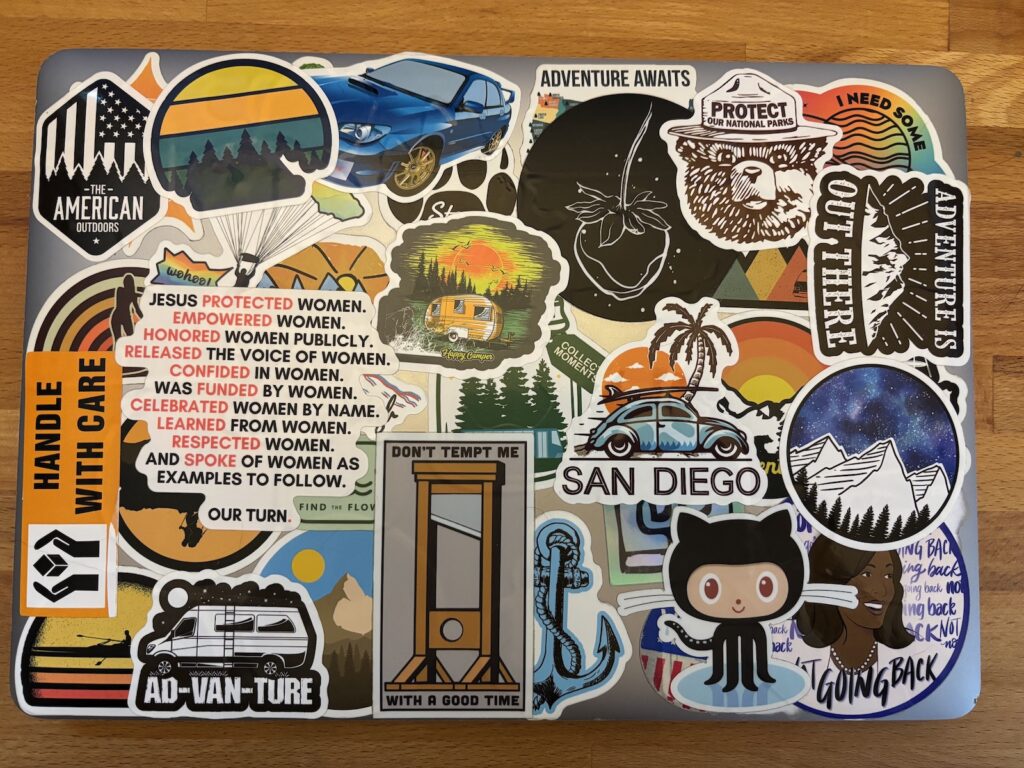
Laptop Stickers
Jul 29, 2025 at 15:49
Data vs Story
One of the most powerful concepts I have ever come across is taking a step back to understand the difference between data and narrative.
Data points are objective snapshots of information. Bob has been late to 3 out of the last 5 meetings is an example of data.
Story is what we tell ourselves about the data. Bob is inconsiderate is an example of a story.
It may be true that Bob is rude and wastes other people’s time, but that is just one story that could be told from the data we have.
Here’s the super power: find other stories that fit the data. Here’s a few off the top of my head:
Bob has unreliable transportation.
This meeting time conflicts with dropping his child off at school.
Bob’s attendance at this meeting is unnecessary.
Bob is regularly double and triple booked.
Perhaps Bob is an inconsiderate jerk—but you actually have no idea from the information provided whether he is or isn’t. But our brains love to jump straight to stories (Bob is a jerk) with complete confidence (look at how often he’s been late). We’re so certain of our stories that we overlook how little information we really have.
I have made this jump more often than I know and have always regretted it. When I am able to step back and realize A does not necessarily imply B — I can take a step back and look at the situation objectively. Many times this means the stories I’ve been telling myself are wrong, and I can give more grace and kindness. But sometimes I find out that the stories I’ve been telling are too kind, and with some extra objectivity, I should expect better.
In both cases, taking a step back and looking at things with an objective lens and separating out what data I know and what stories I believe enables me to do better.
Read full post →May 29, 2025 at 11:17
An update on electric driving
I’ve been meaning to write an update on my post about electric driving — and only just now have I realized it has been a whole year since that post. Time goes by so fast!
Unfortunately, we had a bit of an accident and completely totaled our Kona (lovingly named Sparky). Thankfully all occupants were okay. It meant though we’d have a new opportunity to re-think what our primary car is.
We found a very lightly used 2024 Ioniq 5 for a significant discount over brand new. (Cars depreciate fast — and this is insane)
The Ioniq 5 was the car I wanted the first time we were shopping, and in the intervening couple of years, they have become much more readily available. As I wrote about last year, I prefer used cars thanks to depreciation, and we actually had a reasonable selection of used Ioniqs across the Denver metro area available. I highly recommend this route — it saved us a bundle on a car that literally only had 400 miles — so was effectively brand new.
The Ioniq 5 solved all the things I didn’t like about the Kona
We got AWD, which we don’t need or care about very much, but is pretty important in blizzards on I70 in the mountains.
Still have heated seats — mostly for back pain. These heat up so fast.
A bit larger, especially in the back seat, so our kids have a bit more leg room.
This car has a more up to date charging system, so it fast charges so fast. We hardly ever think about charging because we have the at-hone charging which saves so much time — we never need to go to a gas station anymore. But if we forget to charge, or want to take a road trip, it’ll only take about 20 minutes to get back to a reasonable charge level.
It also has a bigger battery, so its range is higher than the Kona’s, and we actually charge it less often. (we usually charge only once we get below 50%)
Basically — faster fast charging, longer range, and much more options for fast charging — has all combined and I no longer think about charging or range at all.
Overall — I highly recommend this car if you’re in the market. There have been some reports of challenges online about the charging controller (called the ICCU) and we briefly had a moment of concern driving home from the mountains when we got an error message indicating ours might have a problem. But Hyundai recently issued a software recall on ours, and we haven’t had any additional trouble, so fingers crossed they’ve solved it.
Read full post →May 20, 2025 at 15:47
Apple and Epic
It has really been incredible to watch Apple’s greed and arrogance in their legal fight with Epic. I was dismayed that Apple won nearly all of the claims in their lawsuit because I’m a big proponent that consumers should be allowed to do what they wish with their own devices. I think consumers should be allowed to install alternative apps, including alternative app stores, without interference by platform owners. (And I think this should be true of all computing devices, including cell phones and game consoles.)
Unfortunately, that’s not the law in the US. So Apple won and consumers lost. But the one issue they did lose on was that In App Purchases having zero competition from Apple was deemed to be illegal tying. Basically, because Apple banned developers from even linking to alternative payment solution, they were illegally tying their market dominance in cellphones to another market (in app purchases).
Despite this loss, Apple won approval that monetizing in app purchases even outside of Apple’s system was permitted. All Apple had to do was allow developers to use their own payment system, and charge a fair and reasonable monetization fee for doing so. So the loss in this case for Apple was not nothing, but in the grand scheme of things, fairly minor. Apple had to open up the App Store a smidge, but they could easily still make significant sums of money by continuing to tax all digital purchases that happened on iPhones through apps, whether through IAP or through developers’ own payment systems.
They came up with a system so onerous it was designed never to be used. Malicious compliance to the nth degree. They came up with an onerous auditing requirement, and the fee they decided to charge was 27%. It was designed to ensure that developers would not be able to adopt it. It was designed to cement the illegal tying, but couched in a way that Apple hoped the court would bless.
Maybe the court would have had an Apple VP hadn’t been caught lying in testimony. Or maybe they would have gotten away with it if Apple hadn’t memorialized in writing a bunch of statements to the effect of, “Let’s make this as unappealing as possible.”
Perhaps if Apple had settled on a fee of 10%, or 15%, or maybe even 20% — they would have won full support. They could have shown that they were acting in Good Faith. Instead, they convinced themselves they were special, got greedy, and ended up committing perjury in the process. And now they aren’t going to get anything from a whole host of apps.
Apple won this case. But because they acted like idiots they turned almost total victory into a major loss. They got greedy, and I am loving seeing a Federal Judge put them in their place.
Read full post →Apr 25, 2025 at 11:18
BBC Wildlife Spy Cameras
I was recently watching a wildlife documentary that had such magnificent up-close videos of animals and it was so well done, I found it distracting. “Is this all CGI? Is it AI? Are they splicing lots of different videos together to make it look seamless?” It was really bugging me.
Well, it turns out the BBC has a dung camera to get all that amazing footage. The BBC just released a behind the scenes look at how they make these documentaries and I can’t wait to learn more.
Read full post →Apr 16, 2025 at 15:40
From the Depths of Woe
I’ve really been enjoying the song From the Depths of Woe by Indelible Grace Music. ( Apple Music Link) So many great lyrics, including:
Read full post →From the depths of woe I raise to Thee
A voice of lamentation
Lord, turn a gracious ear to me
And hear my supplication
…
Therefore my trust is in the Lord
And not in mine own merit
On Him my soul shall rest
His word upholds my fainting spirit
His promised mercy is my fort
My comfort and my sweet support
Apr 11, 2025 at 23:06
Greenhouse!
We now have a greenhouse in our backyard!!
We are growing/starting some plants for the garden in it — but the main goal was to replace our patio with a really awesome backyard hangout space.

Why a greenhouse?
Covered so we can enjoy during rain, shine or snow
We had our first thunderstorm in it the other day, the pounding rain on the glass was incredible
Greenhouses are warm! Great for cooler fall and spring days where even just a few extra degrees would make it more comfortable to be outside (and the greenhouse can consistently deliver about a 5º-10º improvement)
They’re enclosed, so even on windy days it’s nice to be outside (helps keep it a bit warmer too when the wind has a bite)
It’s almost like adding a new room onto the house
Love the extra sunshine
Includes windows and shades to help cool on hot summer days (we will see how effective this is!) I’m not sure how usable it will be at solar noon in the middle of August. But we have enough tall trees on the west side, that between those, the windows and shades — I’m hopeful it doesn’t diminish our summer evenings outside by being too hot. I’ll see and report back.
Repeatedly I’ve looked at Alissa while enjoying the greenhouse and said, “This is the best purchase we’ve made in years.”
Read full post →Mar 5, 2025 at 14:01
Bald Eagle Cams
I’ve been obsessed with watching this live feed of bald eagles in California. They’ve got two baby eaglets and it’s so fun to watch them get fed by mom and dad. There’s a third egg, and we’re all just waiting for it to hatch. Hopefully soon!
Read full post →Feb 17, 2025 at 13:46
"I Desire Mercy"
I remember one day on my commute into work, I hopped on to the bus I took every day, and pulled out my phone to read the Bible as was my custom. And whatever reading plan I was on brought me to Matthew 23.
Though I had encountered this chapter numerous times before, for whatever reason that particular day, that particular chapter really hit me hard. Each paragraph begins with a condemnation against the religious leaders, rulers and teachers of Jesus’ day. ‘What sorrow awaits you’ … ‘what sorrow awaits you’ … ‘what sorrow awaits you.’ Truly — it is an epic smackdown of the religious elite of Jesus’ day and is worth reading even if you don’t pick up all the nuance.
And I remember reading this and thinking — how can I make sure that Jesus never says anything like this about me?
These men devoted themselves to God’s teaching. They could cite chapter and verse of everything they believed. But somewhere along the way, they lost the plot. They could cite Hosea 6:6, “I desire mercy not sacrifice” — but when the religious rulers question why Jesus would take care of the lost and lowly, they can’t understand what “I desire mercy not sacrifice” truly means. And so—and to folks who dedicated their lives to learning the Bible, this insult almost can’t be overstated—Jesus told them to go learn what “I desire mercy not sacrifice” means. ( Matthew 9:13) Imagine being told to go learn something you’ve spent most of your life trying to learn. Ouch.
Somewhere along the way, studying theology became more important than putting any of it into practice. Or to put it more pithily: their thinking became more important than their doing.
And so with that in mind, Jesus’ condemnation in Matthew 23 becomes quite convicting. They were so devoted to God’s commandments around tithing (giving a tenth) that they would even make sure to give God a tenth of every herb and spice they grew (today and even then worth only a few cents) while neglecting God’s love of justice, mercy and faith. (Matthew 23:23)
If we are to understand Jesus fully, God seems a lot less interested in our performative displays of piety and a lot more interested in justice, mercy and faith. The Pharisees were so obsessed with being perceived as righteous, they went to the trouble of making sure they didn’t short God even a penny or two on their herb gardens — while robbing God blind by not taking care of those He entrusted to them.
Jesus’ warnings are dire: it is possible to love the Bible so much that you lose sight of loving the people God loves: the lost, the lowly, the broken, those far from God.
I’ve often heard people who acknowledge this problem but say something to the effect of, “Well, I am loving people by not giving them bad theology.” I’ve heard this on topics as wide ranging as end times eschatology, judgment and hell, gay marriage, abortion, and content preferences in music, books, and movies.
Let us not mince words. Bad theology can be deadly. It was bad theology that justified slavery. Bad theology for the extermination of Native Americans. Bad theology for environmental destruction. Bad theology against American democracy. And it’s bad theology that hates everything from guitars, to drums, to dancing in churches that has lead to a significant schism in both Protestantism and our witness.
What to do? I think it goes back to God’s desire in Hosea 6—I desire mercy not sacrifice. God seems to delight in extraordinary and patient grants of mercy, even to his worst enemies. We are most like him when we show people love, grace and mercy — especially at great personal sacrifice. (no wonder this is not popular!)
I also think there’s significant room for us to hold our ‘theological convictions’ with a loose grip. The Pharisees were the product of hundreds of years of serious biblical study culminating in every Pharisee dedicating their lives to the continued study and teaching of ‘biblical values’. We need to have some significant humility. If they can miss the mark so badly, so can we.
I am convinced that when I die, I will hold some beliefs, ideas and theologies that are just simply wrong. That, in the glorious light of Day, all will be illuminated. I’m not sure I can prevent that — so much of our theology is put together by piecing together scraps of scripture and trying to make sense of it. If God wanted us to have a full picture of theology, He probably would have spent more time giving us more than scraps to piece together.
But what He did reveal clearly, over and over and over again: Love Him. Love people.
And even that we aren’t always going to get right. But if He says that’s most important, we must start there. Love God. Love people. Let the chips fall where they may.
Read full post →